- Product |Aug 25, 2026
Hoppscotch v2026.8.0: Unified REST and GraphQL Workspace, MCP Server and more

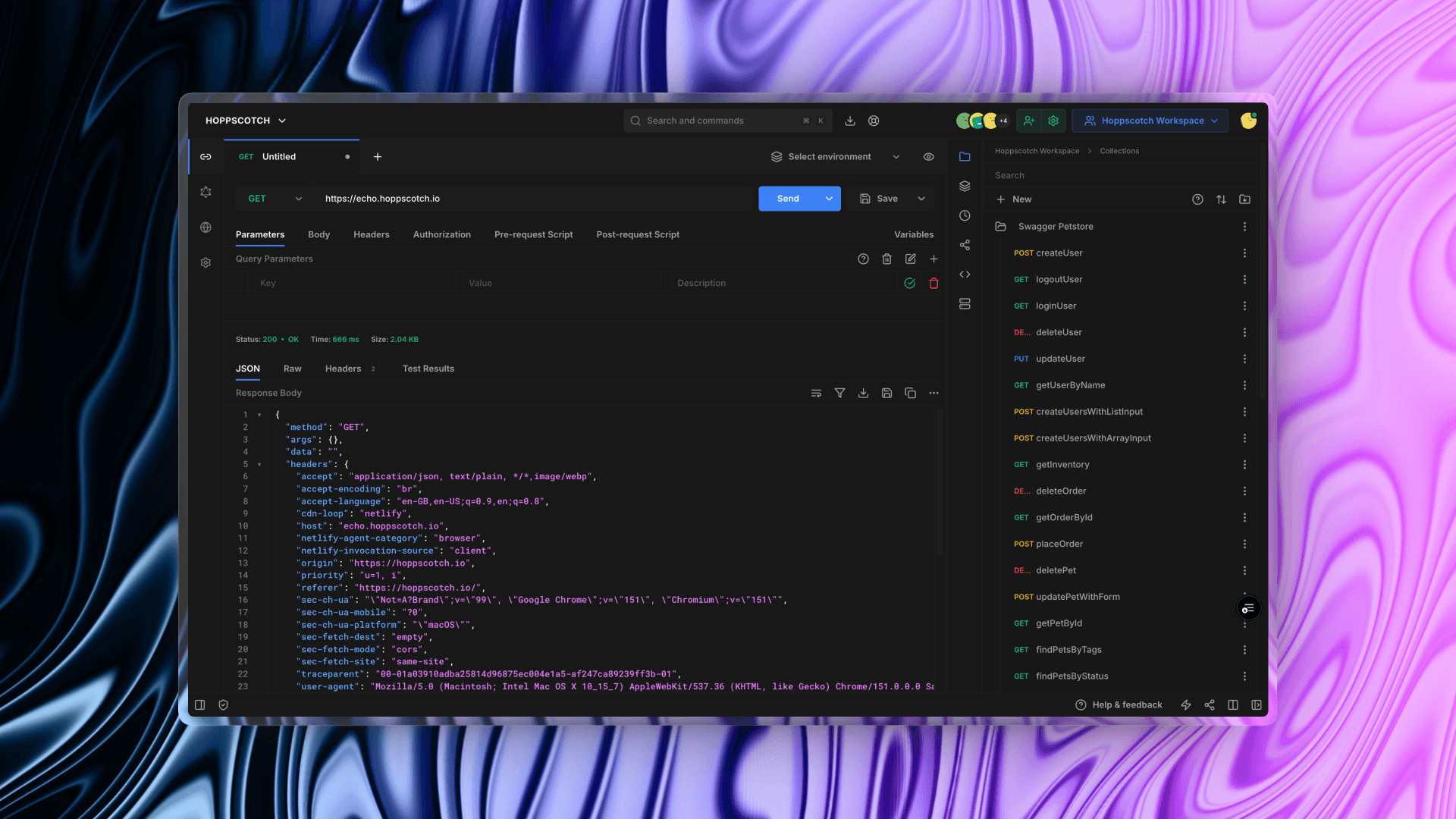
We're excited to announce the release of Hoppscotch v2026.8.0! This update unifies REST and GraphQL into a single workspace, makes the collection runner data-driven, and smooths out cookie handling — and it arrives alongside the new Hoppscotch MCP Server.
A unified REST and GraphQL workspace
REST and GraphQL now share a single workspace. You can create, switch between, and manage both kinds of requests from the same tabbed interface, instead of moving between separate pages. GraphQL brings its tooling with it — the schema explorer and search, schema docs, headers and authorization, variables, and subscriptions with their live log — and subscriptions now also work with servers that speak the newer graphql-transport-ws protocol. A single collection can now mix REST requests with GraphQL queries and mutations in one run. The unified workspace is on by default; if you'd rather keep GraphQL on its own page for now, you can turn it off under Experiments in Settings.
Introducing the Hoppscotch MCP Server
Alongside this release, we launched the Hoppscotch MCP Server. It lets an AI agent in a tool like Claude or Cursor work with your Hoppscotch collections, requests, and environments. See the dedicated announcement for what it does, where it works, and how to set it up.
Read the dedicated announcement →
Data-driven collection runs
The collection runner can now be data-driven. Attach a CSV or JSON data file and the runner executes your collection once per row, exposing each row's columns as variables for that iteration — the data-file workflow many of you know from other API clients. Those iteration values take priority for that run and are never saved. You can also pick a subset of requests to run, and export the run results as JSON.
More predictable cookie handling
A new response cookie sent without a Domain attribute now stays with the exact host that set it, instead of leaking to its subdomains. And when an older Hoppscotch Agent does not return structured cookie data, the app falls back to reading the Set-Cookie response header, so cookies are still captured.
More fixes
On desktop, an instance that needs sign-in could strand you on a screen with no way back to the instance switcher when its sign-in failed. The app now checks for a recorded sign-in failure before resuming such an instance, and opens the instance switcher instead. The connection-timeout dropdown also has a fixed width now.
What do you want us to build next? Write to us at hello@hoppscotch.io, join the conversation on our Discord server, or head over to our GitHub repository.